
One of the things that trouble many people, especially Americans in Japan is that the food, although fantastic, can be intimidating. Whenever I am asked about how to make someone’s first trip to Japan most successful, I always tell them to lean into the food. Eat first, ask what it is later. I have long believed that to understand a culture, you must appreciate the food. This is never more true than in Japan.
In this post, I would like to ease your mind about some of the foods you may come across during your trip that might very well be a challenge……but so worth it.
RAW EGGS
This one is especially difficult because while in Japan you will notice raw eggs have vibrant, orange yolks, not the pale yellow common in the U.S. The very idea of eating raw eggs causes many people to hesitate. No need to worry, as this is absolutely safe in Japan, and you will see them served as part of several meals such as:
Beef Udon, known as Gyudon in Japan. This dish is thinly sliced beef, simmered in a sweet dashi broth. The beef is spread over a bowl of udon noodles and topped with a raw egg. To say this is delicious, is not giving it enough credit.
Many beef dishes come with a small bowl with a raw egg. Simply stir the egg and dip the beef in the egg before each bite. It adds a creamy texture to the bite and truly elevates the dish.
As life-experienced adults, we have been warned of the dangers of raw eggs for many years. While in the U.S., I don’t eat raw eggs out of food safety concerns, but in Japan, I’m all in. I know it’s hard but lean into this, I promise you will not be disappointed.
Verdict: Highest recommendation.
RAW MEATS
Although Japan is known for its fantastic sushi, there is also an abundance of raw meats you may come across. Some of these are much more challenging than others. Following are some of the raw meats I have tried and will give you my candid opinion of the experience.
A5 WAYGU (or Wagyu in general)
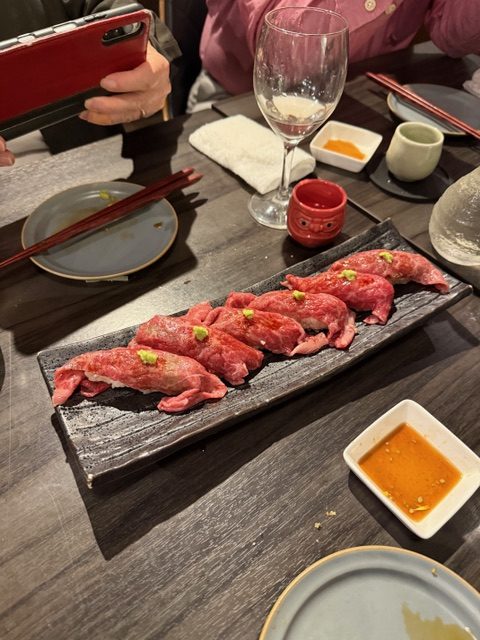
A5 is the gold standard for beef. Sliced thin and often eaten raw as sushi, this one is a must try. A5 is pricey, but at least once during your trip you should have some. There are tons of flattop grill offerings, but if you see it at the sushi bar, go for it. I have had this a few times and I am always glad I did.
Verdict: Highly recommend.
Basashi (raw horse)
I was in Kyushu and I knew basashi was a popular food in that region. Horse meat is eaten both raw and grilled. Basashi, the raw version is a bit intimidating. However, with the sauces and grated radish, it is quite nice. The pictured dish was not the highest quality cut, and I do regret that. I would suggest getting the best cut you can get, as I believe it would move basashi from quite nice to fantastic!
Verdict: Some of you will like it, some will hate it, and a few will go crazy for its unique taste.
Beef Tongue
Beef tongue is popular in several regions of Japan. I’ve had it grilled as well as raw. If like me, you had never eaten this before your Japan trip, I will warn you that the texture will take a minute to come to terms with. It’s a bit tough, but I came to really like it grilled.
I’ve only had it raw once and it was better than I thought it could be. The texture is still a bit of a challenge, but with the dipping sauce, it tasted good. Granted, it’s not my favorite, but I would be happy having it every month or two.
Verdict: The texture will put some people off, but overall, I recommend, especially grilled.
Raw Chicken (toriashi or toriwasa)
This one is perhaps the most difficult for an American to get their head around. From birth, we’ve been taught that eating raw chicken was little more than a suicide attempt. There are two ways I’ve seen this dish.
First is toriashi, which is simply chicken sashimi, raw slices of chicken breast. This requires the biggest leap of faith. The texture is surprisingly appealing, and I really enjoyed it with a ponzu (citrus-based soy sauce).
The second way is toriwasa, a lightly braised chicken breast. In this case lightly braised means that maybe a quarter of an inch on the outside was white, while the bulk of the piece is absolutely raw. It is also sliced sashimi style and a simple soy sauce with a little ginger or chili rounds it out.
What makes this work, as far as food safety goes, is that the chicken served this way will be extremely fresh, as in walking around yesterday fresh. Also, it will be raised cleaner than anything we see in the U.S. It’s scary, but you may very well be surprised by how much you enjoy it.
Verdict: Recommend. The first bite may be scary, but go for it.
WHALE
Finally, one that some visitors reject in concept – as if horse meat didn’t do the job – is whale. The first time Yuka joined me in Japan we stayed in Asakusa. Near the temple there are a few streets filled with open seating restaurants where the food is Izakaya style, with small dishes to be enjoyed with a drink. Yuka noticed that whale croquettes were available and proceeded to share that when she was in elementary school, Japan was still a poor country and that whale croquets were often served for school lunch.
We ordered one serving and I wasn’t prepared for the taste. It tasted like a mammal, while at the same time you knew it was aquatic in nature. Minced, breaded and fried is the only way I’ve eaten whale. I’m glad I tried it, and my life will be just as complete if I never have it again. Don’t misunderstand, if it’s in front of me, I will definitely eat it again but will not seek it out.
Verdict: Recommend for the more adventurous eater, a pass for everyone else.
The point of this post is not to freak anyone out, or to go all Andrew Zimmern on you, but rather to encourage you to lean into the food you see in Japan. For those Life Experienced Adults who grew up in rural areas like I did, it’s about using what is both available and affordable to make a delicious meal.
In the U.S. we have a few decidedly regional foods like grits, or green chilies or regional styles of pizza. In Japan there is immense pride in regional specialties, some of them may challenge you, but if you lean into it with an open mind, you may very well be surprised at how much you enjoy it.
BONUS TIP
As far as regional specialties go, many train stations have information booths about the region. I have yet to find one where there wasn’t at least one English speaker, which makes it easy. I’ve gotten in the habit of stopping in and saying that I’m only in the town/region for a few days and asking what is the ONE dish I should be sure to try while I’m here. I’ve had the best surprises from this.